Claude ASO Analysis: Keywords, Screenshots, Reviews, and Growth
A detailed Claude App Store analysis covering positioning, public keyword signals, screenshot strategy, reviews, pricing, competitors, and growth opportunities.
In this article
- 01Why Claude is a useful ASO case study
- 02Claude App Store snapshot
- 03The title protects the brand; the subtitle defines the category
- 04Public keyword signals center on demanding knowledge work
- 05The screenshots lead with brand before product proof
- 06The description turns thinking into concrete workflows
- 07Visible reviews point to trust and access friction
- 08Pricing supports a professional-use position
- 09Competitive position versus ChatGPT and Gemini
- 10Recommended growth opportunities
- 11What smaller AI apps can learn from Claude
- 12FAQ
Why Claude is a useful ASO case study
Claude competes in a category where several products can credibly claim writing, research, coding, document analysis, and voice. Its App Store challenge is therefore not simply explaining what an AI assistant can do. It must give users a reason to choose Claude over assistants with larger brands, broader ecosystems, or more visible social proof.
Claude's current answer is a thinking-partner position. The listing combines the familiar phrase AI assistantwith language about problem solving, depth, precision, and dependable work. This analysis uses the public United States App Store listing captured on June 27, 2026. Store ranks, ratings, screenshots, and offers can change after publication.
Claude App Store snapshot

Claude by Anthropic
AI assistant for life and work
- Category position
- #2 Productivity
- Rating snapshot
- 4.7 from 184K ratings
- Business model
- Free with in-app purchases
- Developer
- Anthropic PBC
Source: Claude's public US App Store listing.
The title protects the brand; the subtitle defines the category
Claude by Anthropic connects the product to its developer while preserving the distinctive Claude name. The subtitle AI assistant for life and work does two jobs: it establishes the category and widens relevance beyond a single professional use case.
This structure is efficient because the title does not attempt to carry a list of generic terms. The subtitle supplies the category phrase, then uses life and work to communicate breadth. Compared with a line such as Chat, Write, Search & Code, it feels more like a position and less like a feature inventory.
The tradeoff is specificity. A user searching for an AI coding assistant or PDF research tool will not see that task in the title or subtitle. Claude relies on its description, screenshots, ranking, and brand awareness to make those workflows discoverable and persuasive.
Public keyword signals center on demanding knowledge work
Apple does not expose Claude's hidden keyword field, so the defensible analysis is limited to public metadata. Claude's description repeatedly develops several task clusters:
| Cluster | Public language | User intent |
|---|---|---|
| Writing | AI writing assistant, emails, reports, tone, clarity | Turn rough thinking into polished communication |
| Coding | Coding assistant, programming help, review, debug | Understand and solve technical problems |
| Research | Web research, citations, reports, data insights | Investigate a complex question with evidence |
| Visual analysis | PDF, photo, screenshot, chart, diagram | Interpret content that is not plain text |
| Voice | Voice assistant, dictate, brainstorm hands-free | Think and work without typing |
These clusters are coherent because they support the same underlying promise: Claude helps users think through difficult work. For a wider non-brand map, compare them with the AI assistant keyword framework.
The screenshots lead with brand before product proof
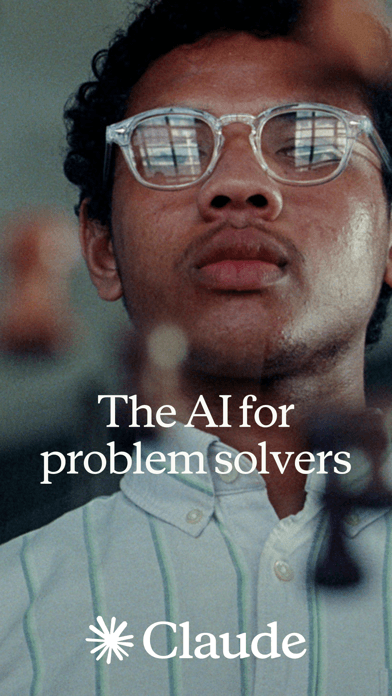

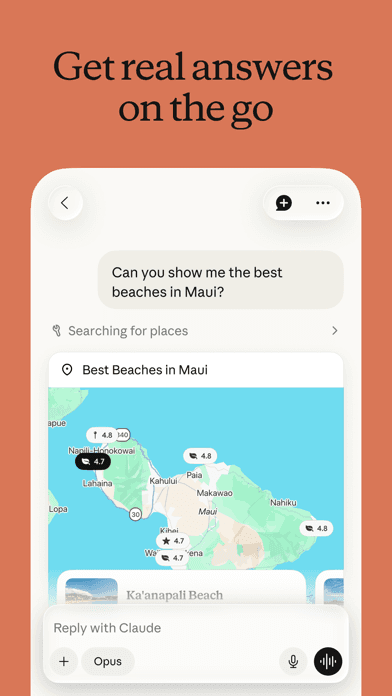
The first screenshot states The AI for problem solvers. It is a strong positioning line: specific enough to signal a serious assistant, but broad enough to cover multiple workflows. The second, Keep thinking, reinforces brand character rather than introducing a separate feature.
Only the third frame moves into direct product demonstration with Get real answers on the go and a travel-search example. The sequence behaves more like a brand campaign than a conventional feature carousel.
This is distinctive, but it creates a conversion tradeoff. Existing Claude awareness may make two brand-led frames effective. Cold non-brand traffic may need earlier evidence of writing, research, coding, documents, or voice. A Custom Product Page could preserve the brand sequence for broad traffic while giving task-specific campaigns a faster route to product proof.
The description turns thinking into concrete workflows
Claude's description is substantially more specific than its subtitle and opening screenshots. It moves from the thinking-partner concept into writing, coding, research, connected context, visual analysis, voice, translation, reports, meeting notes, and planning.
That depth supports users who read beyond the screenshot carousel, but the strongest App Store listings do not rely on long description copy to communicate essential value. The most commercially important workflows should appear in the first visible creative sequence as well.
- Keep the problem-solver position as the opening frame
- Use frame two to demonstrate one difficult workflow
- Use frame three to prove depth, sources, or context
- Move secondary breadth later in the sequence
Visible reviews point to trust and access friction
The visible review examples are not a representative dataset, but they show useful themes for deeper review analysis. Positive language discusses accessibility, clear explanations, reliability, research, adaptation to the user, and a simple interface. That supports the thinking-partner promise with practical value.
Critical visible reviews raise login loops, error screens, account access, support response, restrictions, and the loss of accumulated work or context. These complaints are especially important for an AI assistant because trust depends on continuity. A product that becomes part of someone's workflow creates a higher cost when access fails.
Messaging opportunities
- Explain complex work clearly
- Adapt to the user's context
- Support writing, research, and coding depth
Product risks to monitor
- Login and account recovery
- Reliability after updates
- Support and moderation transparency
A proper study should sample and classify a larger review set. The review intelligence guide explains how to separate recurring evidence from memorable anecdotes.
Pricing supports a professional-use position
Claude is free to download and offers Pro and Max subscriptions in the public listing. The tier structure implies that usage capacity and access to stronger capabilities matter to frequent users. This fits the life-and-work position better than a purely entertainment-led subscription would.
The listing still needs to connect paid value to outcomes. Users do not purchase abstract model access; they pay because important work can be completed with fewer limits, more depth, or greater reliability. Store messaging should prepare that value story without turning the first screenshots into a pricing table.
Competitive position versus ChatGPT and Gemini
ChatGPT owns a broad everyday position and a much larger visible rating base. Gemini connects assistance to Google products and proactive context. Claude's clearest opportunity is not to imitate either advantage. It is to own demanding thinking and knowledge work more explicitly.
The full ChatGPT, Claude, and Gemini comparison shows how the three subtitles, descriptions, rating bases, and ecosystem signals differ.
Recommended growth opportunities
- Move one workflow into frame two. Keep the problem-solver brand, then immediately demonstrate research, writing, coding, or document analysis.
- Create task-specific product pages. Match acquisition for coding, writing, research, and study to dedicated screenshot sequences.
- Use review language as proof. Validate recurring themes such as clear explanations and contextual adaptation before turning them into claims.
- Reduce continuity anxiety. Make account, history, privacy, and connected-context expectations easier to understand.
- Localize the position, not just the words. Claude currently supports fewer storefront languages than some larger rivals, creating room for market-specific expansion.
What smaller AI apps can learn from Claude
- Use a familiar category phrase before inventing new terminology
- Build the position around a user identity or valuable job
- Let brand creative and product proof support each other
- Do not claim hidden competitor keywords as fact
- Treat reliability and account access as conversion issues
FAQ
What is Claude's main App Store position?
Claude positions itself as an AI assistant for life and work, with a stronger emphasis on problem solving, thinking, writing, research, and coding than on entertainment.
What keywords does Claude use?
Public metadata contains language around AI assistance, writing, coding, research, data insights, PDF and visual analysis, voice, and professional work. Claude's hidden keyword field is not public.
What is strongest about Claude's screenshots?
The opening frames create a distinctive problem-solver identity. Their tradeoff is that cold traffic must wait longer for concrete product proof.
How often should this analysis be updated?
Check the listing monthly and update this article when the subtitle, opening screenshots, pricing structure, category position, or core product promise changes.
Continue your ASO workflow