Whatnot ASO Analysis: Live Shopping, Keywords, and Conversion
Analyze Whatnot's live shopping App Store strategy across positioning, public keyword signals, screenshots, buyer trust, seller growth, reviews, and conversion.
In this article
- 01Why Whatnot is a distinctive marketplace case study
- 02Whatnot App Store snapshot
- 03The title balances buyers, sellers, and community
- 04Public keyword signals cover format, categories, and trust
- 05The first screenshot demonstrates the product format
- 06The description expands a buyer-first listing into a two-sided story
- 07Visible reviews reveal an education and trust gap
- 08Growth opportunities
- 09What marketplace teams can learn from Whatnot
- 10FAQ
Why Whatnot is a distinctive marketplace case study
Whatnot does not compete only on inventory, price, or seller tools. Its defining App Store position is a transaction format: live shopping. The app combines video hosts, chat, auctions, giveaways, direct purchases, community, and category discovery in one mobile experience.
This gives Whatnot a clear differentiation advantage and a conversion challenge. The listing must make live shopping feel exciting without hiding the mechanics and trust requirements of real-time bidding. This analysis uses the public US App Store listing captured on June 28, 2026.
Whatnot App Store snapshot

Whatnot: Shop, Sell, Connect
The Live Shopping Marketplace
- Category position
- #3 Shopping
- Rating snapshot
- 4.7 from 885K ratings
- Business model
- Free marketplace app
- Platform
- iPhone
The title balances buyers, sellers, and community
Shop, Sell, Connect names the three participants in Whatnot's growth loop. Shop attracts demand, sell attracts supply, and connect explains why the live experience is more than a catalog. The subtitle then owns the more specific category phrase The Live Shopping Marketplace.
This structure is stronger than a title built from product categories alone. Whatnot can expand from cards and collectibles into fashion, beauty, electronics, plants, and other verticals without changing its core position. The format remains live even when the inventory mix changes.
Public keyword signals cover format, categories, and trust
| Cluster | Public language | User intent |
|---|---|---|
| Format | live shopping, auctions, flash sales, live shows | Interactive, time-sensitive shopping |
| Buyer value | deals, giveaways, name brands, hard-to-find products | Entertainment, value, and discovery |
| Categories | cards, coins, fashion, comics, sneakers, electronics | Specific inventory and collector demand |
| Seller | sell live, small business, make more | Reach demand through hosted commerce |
| Trust | buyer protection, damaged, missing, not as described | Reduce transaction uncertainty |
Whatnot's hidden keyword field is not public. The defensible analysis is based on visible metadata, description, creative, reviews, and rank. The marketplace keyword guide expands these clusters into a reusable framework.
The first screenshot demonstrates the product format
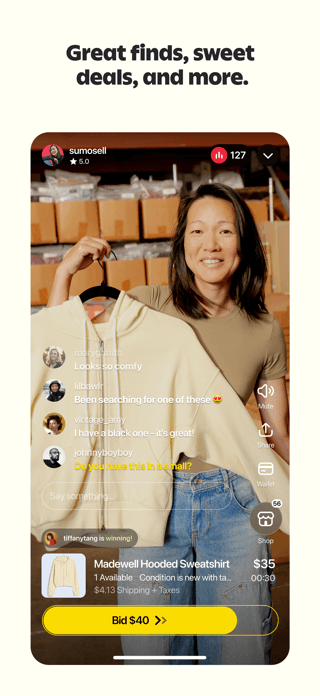

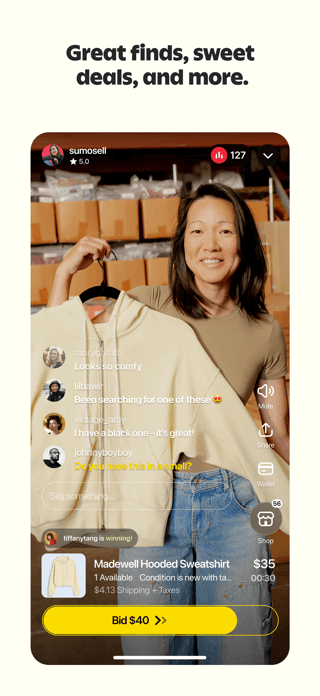
Great finds, sweet deals, and more sits above a real live-show interface containing the host, viewer count, chat, product, price, timer, and bid control. This is strong product proof: a visitor can understand that Whatnot feels different from static ecommerce before reading the description.
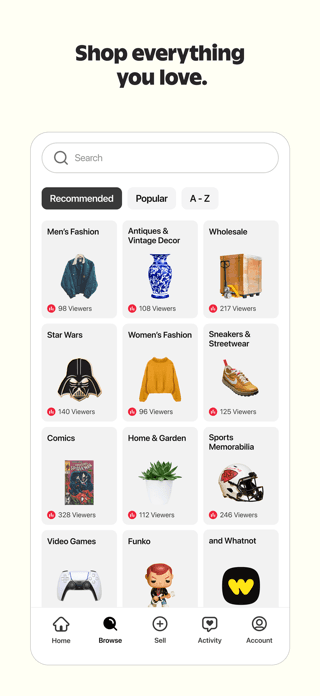
The next frame, Shop everything you love, replaces live energy with category breadth. The sequence first explains how shopping works, then reassures users that the format supports many interests.
Compared with Vinted and Depop, which lead with seller fees, Whatnot is buyer-first. The three-marketplace comparison examines that acquisition choice in detail.
The description expands a buyer-first listing into a two-sided story
The public description moves from category breadth and deals into live auctions, flash sales, giveaways, chat, buyer protection, and finally seller opportunity. This ordering supports the marketplace flywheel: demonstrate demand and engagement before asking a seller to invest in hosting a show.
The seller section references small-business sales volume as proof. Large commercial claims should remain dated and sourced because they can change. The durable message is that sellers gain access to an engaged live audience rather than simply another listing page.
Visible reviews reveal an education and trust gap
Visible review examples praise fun, community, specialist sellers, good deals, and the feeling of exploring real booths. Critical examples raise bidding comprehension, rapid price changes, repeated payment transactions, seller quality, item condition, shipping charges, disputes, and support.
These are directional examples, not a quantified review study. They still reveal an important conversion issue: a live auction is more complex than tapping a fixed-price Buy button. New users need to understand bidding limits, show rules, shipping, cancellation, and protection without draining the experience of excitement.
- Teach bidding before the first high-intent action
- Make shipping and multi-item charges easier to predict
- Show how seller reputation and item condition are evaluated
- Clarify what Buyer Protection covers and how disputes work
Use the review-led conversion framework to test whether these themes recur across a balanced, recent sample.
Growth opportunities
- Add a how-live-bidding-works frame. Preserve the emotional first screenshot, then reduce mechanics anxiety.
- Create category-specific product pages. Match sports cards, fashion, coins, comics, and other acquisition to relevant hosts and inventory.
- Build a seller sequence. Show audience, show setup, fulfillment, and earnings for supply-side campaigns.
- Turn protection into visible proof. Explain the scope and process rather than relying on a generic trust claim.
- Localize by category maturity. Market-specific inventory and seller density should shape creative and keywords.
What marketplace teams can learn from Whatnot
- A transaction format can differentiate more strongly than a product list
- The first screenshot should demonstrate the distinctive experience
- Category breadth needs navigation and liquidity proof
- Buyer excitement and buyer comprehension must grow together
- Seller acquisition deserves its own creative sequence
- Trust metrics belong beside conversion metrics
FAQ
What is Whatnot's main App Store position?
Whatnot positions itself as a live shopping marketplace that combines auctions, hosts, chat, category discovery, deals, and community.
Which public keyword cluster is most distinctive?
Live shopping is the clearest differentiator. Category, seller, auction, deal, and trust language support that central format.
What is the biggest conversion risk?
The excitement of live bidding can outpace a new user's understanding of price, shipping, seller quality, cancellation, and protection.
How often should this analysis be updated?
Recheck the listing monthly and update when the subtitle, opening screenshots, category position, protection message, or seller offer changes.
Continue your ASO workflow