Goblin Tools ASO Analysis: Niche Positioning for a Paid AI App
Analyze how Goblin Tools uses neurodivergent positioning, single-purpose AI utilities, upfront pricing, reviews, and a free web product to compete.
In this article
- 01Goblin Tools sells relief from specific moments of friction
- 02US App Store snapshot
- 03Audience-first metadata creates a moat and a ceiling
- 04One screenshot cannot explain a multi-tool product
- 05The paid app is also a support model
- 06Localization and listing freshness send mixed signals
- 07Reviews confirm the niche and expose product gaps
- 08Growth opportunities
- 09Lessons for small paid AI apps
- 10FAQ

Goblin Tools sells relief from specific moments of friction
Goblin Tools does not position itself as a general AI assistant. It offers small, single-purpose tools for moments when a task, message, tone, time estimate, brain dump, or meal decision feels difficult to process. The current subtitle, Smart tools for the neurospicy, names the audience before explaining the technology.
This is a strong niche strategy because the category is defined by recurring user problems rather than model capabilities. The risk is discoverability: users may search for “break tasks into steps” or “tone checker” without knowing the Goblin Tools brand or the “neurospicy” identity term.
US App Store snapshot
Snapshot checked June 28, 2026. Goblin Tools is $2.99, shows a 4.8 rating from about 2.9K ratings, and appears at #3 in Utilities. The listing identifies Skyhook as the developer and describes the app as the paid version of the free goblin.tools website.
| Tool | User problem | Search-intent language |
|---|---|---|
| Magic Todo | A task feels too large or vague | break tasks into steps, ADHD to-do list |
| Formalizer | A message needs a different tone | rewrite tone, make text more formal |
| Judge | The tone of a message is unclear | tone checker, interpret message tone |
| Estimator | Time required is difficult to judge | task time estimate, planning helper |
| Compiler | A brain dump needs structure | brain dump to tasks, organize thoughts |
| Chef | Ingredients need to become a meal | recipe from ingredients, meal idea generator |
Audience-first metadata creates a moat and a ceiling
The subtitle creates immediate recognition for users who identify with neurodivergent or “neurospicy” language. It also differentiates the app from broad AI assistants that lead with writing, search, or chat. That specificity improves message fit even when total demand is smaller.
The ceiling appears when functional queries are absent from visible metadata. Candidate clusters include neurodivergent productivity, executive function, ADHD task planning, task breakdown, tone rewriting, social communication, time estimation, and brain-dump organization. These should be validated rather than stuffed into a single subtitle. Use the AI app keyword framework to map each job to a defensible term.
One screenshot cannot explain a multi-tool product
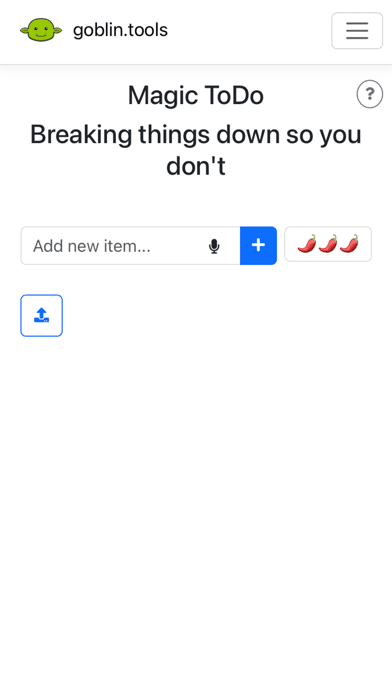
The current iPhone listing exposes one screenshot: the Magic ToDo interface with the line “Breaking things down so you don't.” It establishes the brand voice and most recognizable workflow, but it does not show the task decomposition result or any of the other tools.
A stronger sequence would show: a large task becoming manageable steps, a message changing tone with Formalizer, a brain dump becoming actions with Compiler, and a compact grid introducing Judge, Estimator, and Chef. Each frame should state the moment of friction, then show the output.
The paid app is also a support model
The listing says the website remains free and publicly available and that app purchases first help keep it free and ad-free before supporting the author. The $2.99 price therefore combines utility, convenience, and patronage.
This is different from a conventional paid AI subscription. The conversion message should make the trade explicit: users can try the web product, then buy the app for a native surface and to support the ecosystem. Compare this model with other upfront purchases in Streaks vs Things 3.
Localization and listing freshness send mixed signals
The description says more than 70 interface languages are supported, but the public App Store information currently lists English as the app language. Even if the product supports those translations, the store metadata does not communicate the same breadth.
The visible version history is also limited, while the listing relies on one screenshot. That does not prove the service is inactive, but it creates an acquisition question. Store assets should make current language support, cross-surface sync, and product maintenance easier to verify.
Reviews confirm the niche and expose product gaps
Visible reviews strongly associate the product with executive dysfunction, task initiation, tone interpretation, and daily value. That validates the audience-first positioning. Other visible comments mention crashes, saving edited tasks, recurring routines, category control, and broader question support.
These themes should be grouped by tool and version before affecting listing copy. A Magic Todo retention complaint is not the same as a Chef output complaint or a crash. Use the negative-review ASO process to separate conversion objections from product roadmap requests.
Growth opportunities
- Expand the screenshot sequence. Demonstrate the input and output of at least four core tools.
- Bridge identity and function. Preserve “neurospicy” while adding validated task, tone, and planning language.
- Clarify web versus app value. Explain native convenience, sync, privacy, and ecosystem support without inventing exclusivity.
- Align language metadata. Make public localization signals match real product support.
- Address reliability carefully. Track crash and persistence themes by version before making trust claims.
- Own the narrow category. The low-competition app framework explains why a painful niche job can outperform a broad AI promise.
Lessons for small paid AI apps
- Lead with the audience problem, not the model
- Package AI into repeatable, named jobs
- Use a free web experience to reduce paid-app uncertainty
- Make input-to-output proof visible in screenshots
- Treat accessibility, reliability, and localization as product trust
Use the competitor analysis framework to compare niche job ownership rather than raw feature counts.
FAQ
What is Goblin Tools' main ASO advantage?
It owns a clear audience and packages AI into named tools for specific moments of executive and communication friction.
Why is the app paid if the website is free?
The listing says app purchases help keep the public website free and ad-free before supporting the author.
What is the biggest listing weakness?
A single screenshot cannot explain the product's multi-tool value or demonstrate most input-to-output workflows.
Should other AI apps copy the “neurospicy” subtitle?
No. They should copy the audience specificity, not the wording. Positioning must reflect the users and jobs the product genuinely serves.
Continue your ASO workflow