Vinted vs Depop vs Whatnot: App Store Positioning Compared
Compare how Vinted, Depop, and Whatnot position buyer value, seller economics, marketplace format, screenshots, trust, and growth in the App Store.
In this article
- 01Three marketplaces solve different discovery problems
- 02App Store snapshot
- 03The metadata defines three different markets
- 04Vinted and Depop compete for sellers in the first frame
- 05The second frames reinforce different growth loops
- 06Seller economics are powerful but easy to overstate
- 07Category strategy: fashion depth versus broad live discovery
- 08Trust is the conversion constraint shared by all three
- 09What each listing currently does best
- 10Growth opportunities
- 11Lessons for marketplace teams
- 12FAQ

Three marketplaces solve different discovery problems
Vinted, Depop, and Whatnot all connect buyers and sellers, but their App Store positions are not interchangeable. Vinted organizes its promise around pre-loved goods, easy selling, and seller economics. Depop narrows the market toward thrift clothing, vintage, streetwear, fashion identity, and creator-led resale. Whatnot differentiates through live shopping, auctions, entertainment, community, and broad collectible categories.
This comparison uses the public United States App Store listings captured on June 27, 2026. Rankings, ratings, screenshots, events, fee structures, and product claims can change.
App Store snapshot

Vinted
Vinted: Pre-loved marketplace
Sell & buy second-hand clothes
#1 Shopping
4.8 from 96K ratings

Depop
Depop - Buy & Sell Clothes
Thrift Clothing Marketplace
#3 Shopping
4.8 from 879K ratings

Whatnot
Whatnot: Shop, Sell, Connect
The Live Shopping Marketplace
#2 Shopping
4.8 from 884K ratings
Rating counts are rounded to match Apple's storefront display.
The metadata defines three different markets
| App | Category phrase | Primary audience signal | Main differentiator |
|---|---|---|---|
| Vinted | Pre-loved marketplace | People selling and buying second-hand clothes | Simple resale economics and reuse |
| Depop | Thrift clothing marketplace | Fashion buyers, sellers, and creators | Style, vintage, streetwear, and fashion community |
| Whatnot | Live shopping marketplace | Live buyers, collectors, and small sellers | Entertainment-led discovery and auctions |
Vinted and Depop use inventory language to narrow a broad marketplace category. Whatnot uses transaction format. Both approaches are valid: one tells users what they will find, while the other tells them how shopping will feel.
Vinted and Depop compete for sellers in the first frame


Vinted opens with Sell with no fees and Pocket all your earnings. Depop opens with Keep more of your cash with no selling fees, then qualifies that payment processing and boosting fees still apply. Both choose seller economics as the highest-attention conversion message.
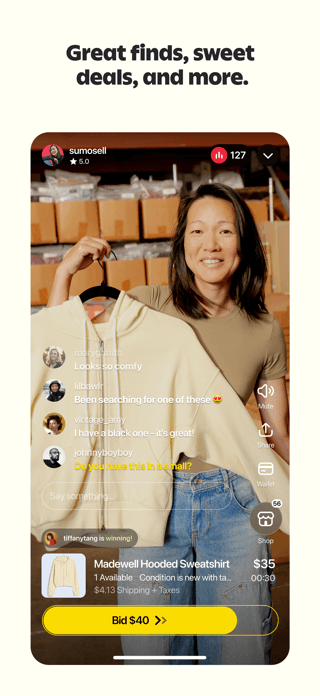
Whatnot opens on the buyer experience: a live host, product, chat, viewer count, price, and bid control under Great finds, sweet deals, and more. Its product format is the proof. Rather than explaining live shopping, the frame places the visitor inside a show.
The second frames reinforce different growth loops
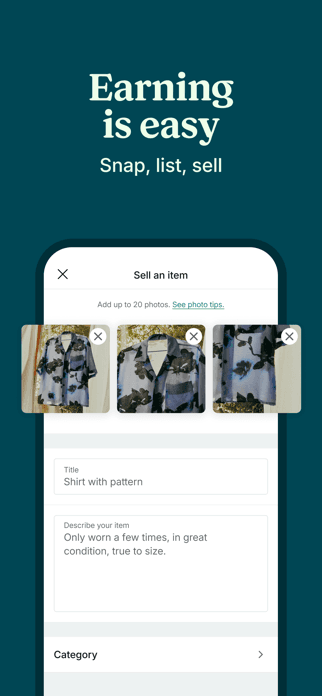

Vinted follows seller economics with Earning is easyand a conventional listing form. Depop uses List in seconds and makes AI-assisted description creation visible. Both attempt to reduce the supply-side cost of creating inventory.
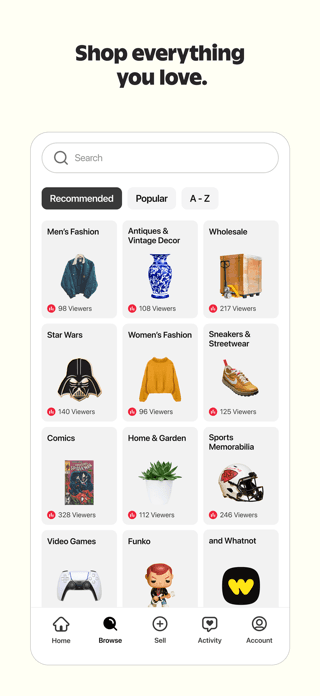
Whatnot follows live energy with Shop everything you loveand a broad category grid. That move reassures users that live shopping is not confined to one collector niche. It supports buyer retention by expanding the number of interests that can produce a relevant show.
Seller economics are powerful but easy to overstate
No-selling-fee messaging is compelling because it answers a direct seller question: how much of the sale do I keep? It is also a claim that requires precise qualification. Payment processing, promotion, shipping, protection, withdrawal, or other service costs may still shape total seller economics.
Vinted supports its message in the public description with seller-keeps-earnings language, prepaid labels, buyer-paid shipping, and bank transfer. Depop highlights no selling fees while disclosing possible payment-processing fees. Clear qualification protects trust and reduces the chance that acquisition copy creates review friction.
Category strategy: fashion depth versus broad live discovery
Depop is the most fashion-specific. Its public description develops vintage, thrift, streetwear, name-brand clothing, trends, self-expression, and creator community. Vinted begins with clothes but extends the pre-loved idea into broader categories and household decluttering.
Whatnot covers fashion alongside cards, coins, comics, electronics, sports, plants, jewelry, and hundreds of other categories. Its unifying idea is not a product vertical; it is the live, social, auction-like format. That creates broad expansion potential but requires stronger navigation, trust, and seller-quality systems.
The marketplace keyword guide shows how to choose between buyer, seller, category, format, trust, and economics terms.
Trust is the conversion constraint shared by all three
Marketplace growth creates risk as quickly as it creates selection. Buyers need accurate listings, delivery, payment protection, and a usable dispute process. Sellers need predictable moderation, payouts, shipping, account access, and support.
Visible review examples for Vinted raise scams, account blocking, payments, and support. Depop examples raise authenticity decisions, suspensions, shipping, fees, and support response. Whatnot examples praise entertainment and community while also raising bidding, seller quality, shipping, and dispute friction. These visible reviews are directional, not a quantified sample.
| App | Conversion promise | Risk to monitor |
|---|---|---|
| Vinted | Easy selling and buyer protection | Support, scams, payment, and account enforcement |
| Depop | Fast fashion resale and safe checkout | Authenticity, fees, shipping, and appeals |
| Whatnot | Fun live deals with buyer protection | Bidding comprehension, seller quality, and disputes |
Apply the review-led conversion framework before turning any visible complaint or compliment into listing copy.
What each listing currently does best
Vinted
Connects pre-loved values to a direct seller-economic benefit and a simple listing workflow.
Depop
Owns a fashion-specific language system and makes fast, AI-assisted supply creation visible.
Whatnot
Demonstrates a differentiated live experience immediately, then proves category breadth.
For a deeper look at the live-commerce model, read the dedicated Whatnot ASO analysis.
Growth opportunities
Vinted: bring trust closer to the seller promise
No-fee selling is strong acquisition copy. A nearby frame explaining shipping, payout, or protection could reduce the uncertainty that appears in visible review friction.
Depop: balance seller acquisition with buyer identity
The first frames make supply creation compelling. A fashion-discovery frame tailored to vintage, streetwear, or creator closets could make the buyer side equally distinctive.
Whatnot: teach live-shopping mechanics earlier
The live frame is differentiated, but new users may not understand bidding, show rules, shipping, or seller quality. Creative that demonstrates safe participation could support conversion quality.
Lessons for marketplace teams
- Choose whether inventory category or transaction format defines the market
- Acquire the constrained side without making the other side invisible
- Treat fees, protection, and authenticity as supportable promises
- Show the transaction experience, not only a catalog
- Measure listing conversion together with transaction quality
- Use review clusters to find expectation gaps before rewriting creative
FAQ
How do Vinted and Depop position differently?
Vinted emphasizes a pre-loved marketplace, simple resale, and seller economics. Depop is more explicitly centered on thrift fashion, vintage, streetwear, creators, and style identity.
What makes Whatnot different from Vinted and Depop?
Whatnot uses live shopping and auctions as the defining format and spans a much broader range of product categories.
Which app has the strongest screenshot strategy?
Each is strong for a different job. Vinted and Depop make seller economics and listing speed clear. Whatnot demonstrates its differentiated live shopping experience immediately.
Can visible App Store reviews determine which app is best?
No. Featured reviews are directional examples, not a representative comparison. A defensible conclusion requires a balanced, dated review sample and product metrics.
Continue your ASO workflow